
Concrete Post
Because a concrete post does not corrode, it brings the lifetime maintenance cost of a long land run down to almost nothing.
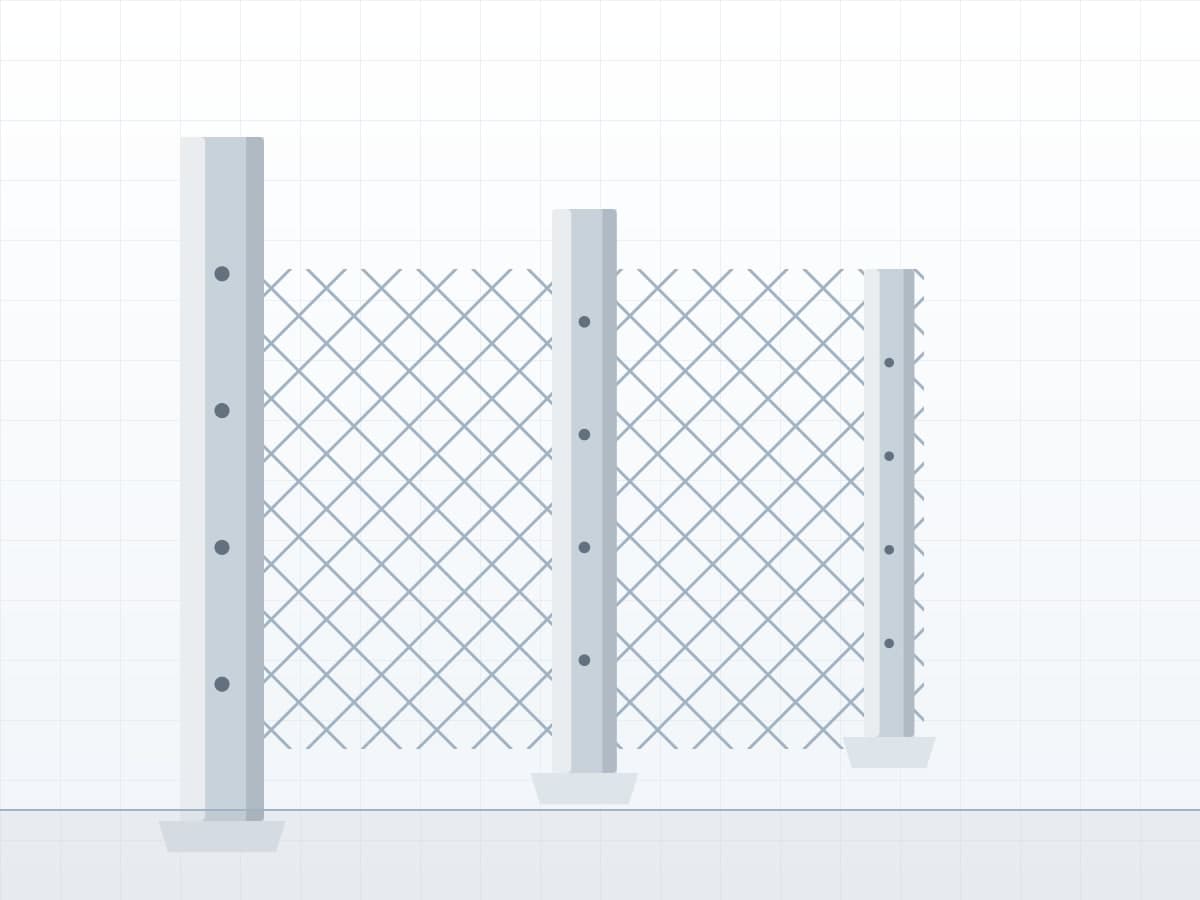
The real advantage of a concrete post over a steel one is that it does not corrode. The section in contact with the soil is where the coating on a galvanised tube is spent fastest; a concrete post has no such weak point. As long as the reinforcement inside stays covered by concrete, the post keeps its load-bearing capacity.
The holes cast into the body set out in advance where the line wires will pass. That removes the job of measuring and drilling on site and noticeably speeds installation on long runs. Because the line wires pass through the holes, the load is transferred directly into the body of the post.
The load-bearing logic of a run is established at its corners. Intermediate posts only carry the wire, while corner and end posts take the entire tension load; we set those posts deeper and brace them with struts. Without a strut a corner post leans towards the run over time under the tension.
Frequently asked questions
On long stretches of land that are hard to maintain a concrete post makes more sense; it does not rust and needs no paint. Around estates, gardens and facilities where appearance leads, a galvanised post looks slimmer and tidier.
The post is placed in a hole dug so that part of its overall length stays below ground and is fixed with concrete. Corner and end posts are set deeper and are additionally supported with struts.
Get a quote for Concrete Post
Tell us the length and the condition of the ground; we will send your detailed quote within 48 hours of the survey.