
Barbed Wire
Barbed wire is the classic way of adding deterrence to long land boundaries and fence tops at the lowest possible cost.
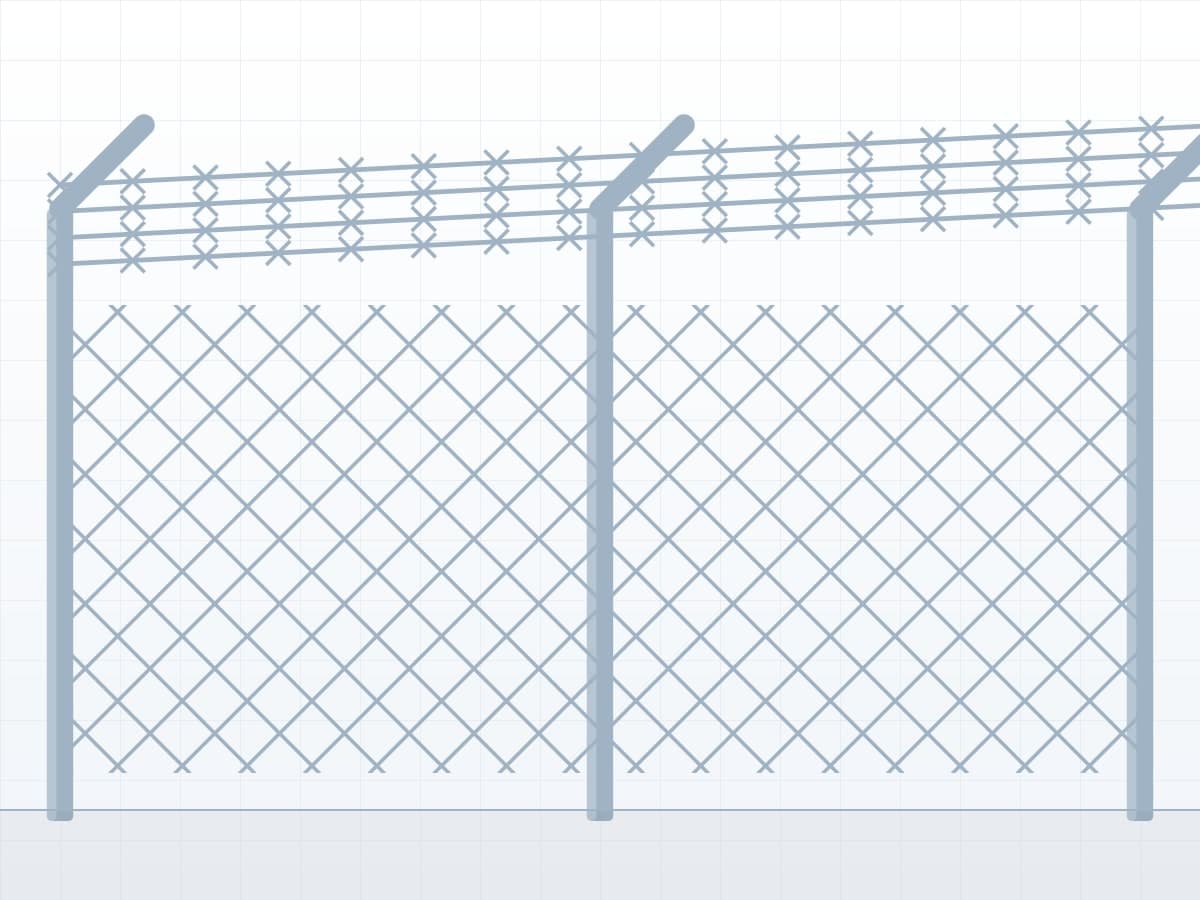
Barbed wire is made by twisting two wires around one another and binding barbs between them at set intervals. That twisted structure lets the wire hold its tension; where a straight wire that expands in heat and contracts in cold sags over time, a twisted wire absorbs the movement within itself.
On top of a fence, barbed wire only makes sense with a cranked arm. The angled arm fitted to the head of the post carries the wire outside the plane of the fence and pushes the climber’s body back. A Y type arm opens in both directions at once and makes climbing harder from inside as well as outside.
Along a land boundary the number of rows and the spacing between them decide the result. Closely spaced lower rows stop animals getting through, while the spacing of the upper rows is aimed at slowing a person down. Every row is strained separately; tensioning from a single point lets the whole run sag.
Frequently asked questions
The number of rows depends on what the line has to do. To stop animals getting through, the lower rows are spaced more closely; as fence topping, a few rows over a cranked arm are enough. We look at the site before advising.
Barbed wire creates a risk of contact through barbs at intervals and is economical over long runs. Razor wire presents a continuous sharp surface and is a far stronger deterrent, which is why critical facilities use it.
Get a quote for Barbed Wire
Tell us the length and the condition of the ground; we will send your detailed quote within 48 hours of the survey.